
Are Your Fiber Networks Ready for 400G, 800G and Beyond?

Higher speeds are changing the requirements for fiber networks
The demand for higher speeds and greater bandwidth in telecom and data networks continues to grow. Artificial intelligence, cloud services, data centers, high-resolution video, remote work, industrial automation and the rapid growth of connected devices are all contributing to rapidly increasing data traffic and bandwidth requirements.
As a result, network speeds have evolved from megabit levels to 1G, 10G, 100G, 400G, 800G and beyond.
But increasing network speed is not simply a matter of upgrading the active equipment. As transmission rates increase, the underlying fiber infrastructure also becomes increasingly important.
A fiber link that performs well at one speed may not necessarily provide the same margins when the network is upgraded to significantly higher transmission rates. As transmission rates increase, the available margin for signal degradation becomes increasingly important. Factors such as fiber type, link length, attenuation and dispersion all contribute to the overall performance of the optical link.
When higher speeds put the fiber to the test

At very high transmission speeds, characteristics of the optical fiber that may have had limited impact at lower speeds can become much more significant.
One example is dispersion.
Dispersion can affect the quality of a transmitted signal as it travels through the fiber and can become an important factor when increasing both transmission speed and distance. This means that, as networks move towards 400G, 800G and beyond, understanding the characteristics of the existing fiber infrastructure becomes increasingly important.
The question is therefore not only whether a fiber link is working today, but whether the fiber is suitable for the performance requirements of tomorrow’s network.
Knowing your fiber infrastructure
When upgrading an existing network, replacing equipment is often only part of the challenge. The fiber infrastructure itself needs to be evaluated to determine whether it can support the intended performance.
This is where accurate fiber testing can provide valuable insight.
By measuring parameters such as Chromatic Dispersion (CD), Polarization Mode Dispersion (PMD) and Attenuation Profile (AP), technicians and engineers can gain a better understanding of the optical characteristics of a fiber link.
Chromatic Dispersion (CD)
Different wavelengths travel at slightly different speeds through the fiber. Over distance, this can cause the optical signal to spread and affect signal integrity.
Polarization Mode Dispersion (PMD)
PMD occurs when different polarization components of an optical signal travel at slightly different speeds through the fiber. At high transmission rates, this can become an important factor in link performance.
Attenuation Profile (AP)
The attenuation profile shows how optical loss varies across the measured wavelength range, providing additional insight into the characteristics and performance of the fiber.
Together, these measurements can help identify potential limitations and provide a better basis for deciding whether an existing fiber link is suitable for high-speed Ethernet applications.
A flexible platform for high-speed network testing
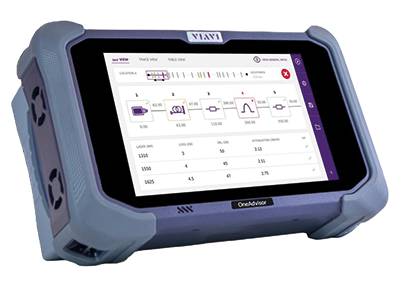
As networks continue to evolve, test equipment also needs to keep pace. Testing solutions need to support today’s requirements while providing the flexibility to adapt as network speeds increase.
The OneAdvisor 800 is a portable and modular test platform designed to support the installation, turn-up and maintenance of high-capacity networks, with test capabilities extending to 800G.
The platform can be used for applications including metro/core, Data Center Interconnect and business services testing. Its modular design allows different test capabilities to be combined on the same platform, depending on the requirements of the network.
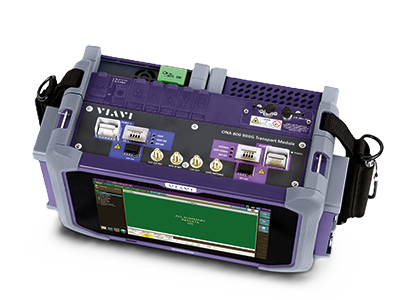
For high-speed transport testing, the OneAdvisor 800 can be equipped with the 800G Transport Module, supporting testing up to 800GE while maintaining the same user interface as the T-BERD/MTS family.
Looking beyond the transmission equipment
High-speed testing is not only about verifying that equipment can transmit at 400G or 800G. The complete optical path needs to be considered — from the transmission equipment and optics to the fiber itself.
Understanding the characteristics of that fiber can be essential when determining whether an existing link is suitable for a higher-speed application.
While the OneAdvisor 800 can be configured for a wide range of fiber and transport measurements, high-speed network qualification may also require a closer look at the optical characteristics of the fiber itself. This is where the Optical Dispersion Measurement Module (ODM) adds an important capability.
ODM is a field test solution that combines measurements of:
- Chromatic Dispersion (CD)
- Polarization Mode Dispersion (PMD)
- Attenuation Profile (AP)
By combining these measurements in a single module, technicians and engineers can assess important optical characteristics directly in the field.
Preparing for what comes next
As networks evolve towards 400G, 800G and beyond, understanding the capabilities of the underlying fiber infrastructure becomes increasingly important.
By combining fiber testing with optical characterization, network operators and service providers can identify potential limitations, verify fiber performance and make better-informed decisions when upgrading existing infrastructure.
Is your fiber infrastructure ready for the next generation of network speeds?
Learn more about the OneAdvisor 800 and how it can be configured for high-speed fiber and transport testing.
Explore featured products
Learn more about the testing solutions mentioned in this article:
- OneAdvisor 800: Explore the Module Test Platform
- Optical Dispersion Measuremnent Module: Explore Field Test Solution